
Financial freedom isn't about having everything. It's about having choices.
Financial freedom is one of those phrases we hear everywhere.
You see it attached to investment portfolios, early retirement, luxury lifestyles and promises of becoming wealthy.
But what does it actually mean?
Does financial freedom mean never working again?
Does it mean owning a million dollars?
Does it mean travelling whenever you want?
Does it mean having no debt?
Does it mean being able to buy whatever you want?
Not necessarily.
Financial freedom looks different for everyone.
For one person, it might mean retiring early.
For another, it might mean having enough savings to leave a job that no longer feels right.
For someone else, it might simply mean opening their bank account without feeling anxious.
At Finance Strategy Co., we believe financial freedom isn’t a number you eventually reach.
It’s the ability to make financial decisions from a place of choice rather than fear.
Financial Freedom Isn't the Same as Being Rich
This distinction matters.
You can earn a high income and still feel financially trapped.
You can have an expensive lifestyle and very little financial flexibility.
You can own beautiful things while carrying significant debt.
And you can have a modest income while building a strong financial foundation.
Income is what you earn.
Wealth is what you build.
Financial freedom is the choice those resources can create.
They’re connected, but they’re not the same thing.
So, What Is Financial Freedom?
At its simplest, financial freedom means having enough financial stability and resources to make meaningful choices about your life.
That might mean being able to:
Handle an unexpected expense.
Take time away from work.
Change careers.
Start a business.
Travel.
Reduce your working hours.
Support your family.
Retire comfortably.
Say no to something that isn’t right for you.
Financial freedom creates options.
And options create freedom.
Financial Freedom Is Personal
There is no universal number that tells you:
“You are now financially free.”
Your version of freedom depends on the life you want.
Perhaps your dream is:
A beautiful home.
More time with family.
Annual travel.
Working for yourself.
Early retirement.
A flexible career.
Financial security.
A debt-free life.
The ability to pursue opportunities without worrying about the financial consequences.
Your definition of freedom should be yours.
The First Level of Financial Freedom: Clarity
Before you can build freedom, you need to understand where you are.
Start with your financial snapshot.
Know:
Your income
Your expenses
Your savings
Your debts
Your investments
Your assets
Your financial goals
Your net worth
You don’t need to have impressive numbers.
You simply need to know your numbers.
Clarity gives you a starting point.
The Second Level: Control
Once you understand your finances, the next step is creating control.
This doesn’t mean controlling every dollar.
It means knowing where your money is going and having a system that supports your priorities.
A strong financial system can include:
A realistic budget
Automated savings
Bill management
Sinking funds
Debt repayments
Investment contributions
Regular financial reviews
Control creates consistency.
And consistency creates momentum.

The Third Level: Security
Freedom is difficult to enjoy when you’re constantly worried about what could go wrong.
That’s why financial security matters.
An emergency fund can provide a financial buffer when unexpected expenses arise.
Your financial safety net might also include:
Appropriate insurance.
Manageable debt.
Stable cash flow.
Savings.
A diversified financial foundation.
Security is the foundation beneath freedom.
The Fourth Level: Flexibility
This is where financial freedom starts to feel different.
Imagine having enough financial flexibility to make choices.
Perhaps you could:
Take a career break.
Move to a new city.
Work fewer hours.
Start a business.
Travel for several months.
Handle an unexpected expense.
Help someone you love.
Flexibility is one of the most valuable forms of wealth.
Because money can create time.
And time creates choice.
The Fifth Level: Wealth Building
Once your financial foundation is stable, you can begin thinking about long-term wealth creation.
Depending on your circumstances, this might involve:
Superannuation
Investments
Property
Business ownership
Other long-term assets
The purpose isn’t simply to accumulate numbers.
It’s to build resources that can support your future.
This is where saving and investing can become part of a larger financial strategy.
The Sixth Level: Choice
At its highest level, financial freedom becomes less about accumulation and more about choice.
You can decide:
Where you live.
How you work.
What you prioritise.
What opportunities you pursue.
How you spend your time.
What you say yes to.
What you say no to.
That’s the real luxury of financial freedom.
Financial Freedom Isn't About Never Working
This is one of the biggest misconceptions.
You might love your career.
You might enjoy running a business.
You might genuinely want to work.
Financial freedom doesn’t mean you have to stop.
It means work becomes a choice rather than your only option.
Imagine continuing to work because you enjoy what you do—not because you’re terrified of what would happen if you stopped.
That’s a very different relationship with money.
Financial Freedom Can Mean Working Less
Perhaps your version of freedom isn’t retirement.
Perhaps it’s working:
Four days a week.
Six months of the year.
From anywhere.
On your own business.
In a role you genuinely enjoy.
The goal isn’t necessarily to eliminate work.
It’s to create more control over your time.
Financial Freedom Can Mean Saying No
There is power in being able to say:
“No, that job isn’t right for me.”
“No, I don’t want to take on that debt.”
“No, I can’t afford to support that lifestyle.”
“No, I’m not willing to sacrifice my priorities for this.”
Financial independence can give your boundaries more strength.
Financial Freedom Can Mean Saying Yes
Freedom isn’t only about saying no.
It’s also about saying yes.
Yes to:
A holiday.
A career opportunity.
A business idea.
A new experience.
Helping someone.
Taking time off.
A home you love.
A life change.
When your finances are prepared, opportunities become easier to consider.
Financial Freedom Starts With Your Definition of Enough
This is one of the most important questions you can ask.
What is enough for me?
Enough income.
Enough savings.
Enough possessions.
Enough experiences.
Enough investment growth.
Enough financial security.
Without a definition of enough, you can spend your entire life chasing more.
Freedom requires knowing when more isn’t necessarily better.

More Money Doesn't Automatically Create More Freedom
It can help.
But more income can also lead to:
Higher expenses.
Lifestyle inflation.
More commitments.
More debt.
More financial complexity.
Earning more isn’t the same as becoming more financially free.
The question is:
“What am I doing with the additional money?”
If your income increases by $20,000 but your lifestyle increases by $20,000 too, your financial flexibility may not change very much.
Lifestyle Inflation Can Quietly Delay Freedom
Lifestyle inflation happens when spending increases as income increases.
A higher salary becomes:
A bigger home.
A newer car.
More subscriptions.
More dining out.
More shopping.
More expensive holidays.
There’s nothing inherently wrong with enjoying more as you earn more.
But if every increase in income immediately becomes a new expense, your future may not benefit.
Financial freedom requires intentional allocation.
Build the Life You Want Before You Build the Wealth You Think You Need
This is a subtle but important distinction.
Don’t spend decades building wealth only to discover you never defined what the wealth was for.
Ask:
“What am I actually building?”
Maybe you’re building:
More time.
A flexible lifestyle.
A secure retirement.
A business.
A family home.
Travel opportunities.
Peace of mind.
Wealth should support your life, not replace it.
Financial Freedom Is About Time
Money is often discussed in terms of purchases.
But one of its greatest benefits is what it can do for your time.
Savings can create breathing room.
Investments can support long-term independence.
Debt reduction can reduce financial pressure.
A profitable business can create flexibility.
Money can buy back choices over your time.
And time is something you can’t earn back.
The Freedom Number
You may eventually want to calculate a personal “freedom number.”
This isn’t one universal figure.
It depends on your lifestyle and goals.
Start by understanding:
Your annual living expenses
Your desired lifestyle
Your financial commitments
Your savings
Your investments
Your expected future income
Your desired timeline
The more clearly you understand these numbers, the more tangible your vision of financial freedom becomes.
Your freedom number should support your freedom vision, not someone else’s.
Financial Freedom Doesn't Require Perfection
You will make mistakes.
Markets will move.
Unexpected expenses will happen.
Your priorities will change.
Your income may fluctuate.
Your plans may need adjusting.
Freedom isn’t about creating a perfect financial life.
It’s about creating a resilient one.
Build a Financial Buffer
A buffer gives you room to breathe.
It might be:
An emergency fund.
Extra cash savings.
A sinking fund.
Available income after essential expenses.
A diversified financial foundation.
The purpose of a buffer isn’t to make you rich.
It’s to make you less fragile.
Reduce Financial Obligations
Freedom becomes easier when fewer of your future paycheques are already committed.
This is why managing debt can be such an important part of your strategy.
Consider:
Credit card debt.
Personal loans.
Car finance.
Mortgage commitments.
Other recurring financial obligations.
The less financial pressure you carry, the more flexibility you may have.
Create Multiple Financial Buckets
Think of your money as having different purposes.
TODAY
Money for everyday living.
SECURITY
Emergency savings and financial buffers.
GOALS
Money for short and medium-term priorities.
FUTURE
Long-term investments and wealth building.
FREEDOM
Money specifically supporting future flexibility.
Your structure may look different.
The principle is to give your money a purpose.
Save for Freedom, Not Just Emergencies
Emergency savings protect you from the unexpected.
But you can also create savings that support opportunities.
Perhaps a:
Career transition fund.
Travel fund.
Business fund.
Home fund.
Freedom fund.
Savings don’t only protect you from what could go wrong.
They can also help you move towards what could go right.
Invest for the Long Term
Saving and investing serve different purposes.
Savings can provide accessibility and security.
Investing is generally about long-term growth and may involve greater risk.
Depending on your circumstances, investing can become an important component of a long-term wealth strategy.
The goal isn’t to chase quick returns.
It’s to build patiently and intentionally.
Don't Chase Financial Freedom Through Quick Fixes
Financial freedom rarely comes from:
Get-rich-quick schemes.
Constantly chasing the next investment trend.
Extreme budgeting.
Avoiding all spending.
Taking unnecessary financial risks.
Sustainable wealth is usually built through consistent decisions over time.
Financial Freedom Is Not a Luxury Lifestyle
Social media often presents financial freedom as:
Private jets.
Luxury cars.
Designer wardrobes.
Five-star hotels.
Huge homes.
But financial freedom may look much quieter.
It could be:
A paid-off home.
A comfortable retirement account.
A healthy emergency fund.
The ability to work fewer hours.
A low-stress lifestyle.
A year of travel.
Freedom doesn’t have to look impressive.
It just has to feel meaningful to you.
The Quiet Luxury of Financial Freedom
There is a quieter version of luxury that rarely appears on social media.
It’s:
Opening your bank account without fear.
Having money set aside for unexpected expenses.
Knowing your bills are covered.
Being able to take a holiday without financial panic.
Having choices when your circumstances change.
Knowing your future is being considered.
That’s financial freedom in its most practical form.
Your Spending Can Either Support or Delay Freedom
Every dollar has an opportunity cost.
Money spent today can’t also be used for:
Savings.
Investments.
Debt reduction.
Future goals.
But that doesn’t mean you shouldn’t spend.
Enjoying your life is part of the strategy.
The question is whether your spending reflects what matters most.
Intentional spending allows you to enjoy your present while continuing to build your future.

Financial Freedom Doesn't Mean Deprivation
You don’t have to eliminate everything you love.
You don’t need to stop:
Dining out.
Travelling.
Buying beautiful things.
Enjoying experiences.
Celebrating.
Instead:
Spend intentionally.
Spend on what matters.
Reduce spending that doesn’t.
Direct some money towards your future.
Freedom should make your life feel bigger, not smaller.
Create a Lifestyle That Doesn't Require Constant Upgrading
One of the most powerful ways to build freedom is to become comfortable with enough.
You don’t need every upgrade.
You don’t need the newest version.
You don’t need to match someone else’s lifestyle.
When your happiness becomes less dependent on consumption, your money can do more for you.
Your Financial Freedom Strategy
If you want to start building towards financial freedom, begin with five questions.
01 – What does freedom mean to me?
Define it.
02 – What does my ideal life cost?
Understand it.
03 – Where am I financially today?
Measure it.
04 – What needs to change?
Identify it.
05 – What is my next step?
Act on it.
Clarity turns an abstract dream into a strategy.
The Finance Strategy Method™
Financial freedom doesn’t happen through one decision.
It is built through a system.
KNOW → ORGANISE → PLAN → BUILD → THRIVE
KNOW
Understand your current financial position.
ORGANISE
Create a financial system that supports your everyday life.
PLAN
Define your goals and your vision of freedom.
BUILD
Save, manage debt and build long-term wealth.
THRIVE
Use your financial foundation to create greater choice, flexibility and freedom.
This is what financial strategy is really about.
Five Signs You're Becoming More Financially Free
Financial freedom can begin long before you reach your ultimate goal.
01 – You know where your money goes.
02 – You have savings that give you breathing room.
03 – Your debt is becoming more manageable.
04 – Your financial decisions are increasingly intentional.
05 – You have more choices than you used to.
Notice something?
None of these require you to be wealthy.
Freedom can begin with a feeling of control.
Your Financial Freedom Vision
Take a moment and imagine your life five or ten years from now.
Where do you live?
How do you spend your time?
What does your work look like?
Who are you spending time with?
What experiences matter?
What financial worries are no longer present?
What choices can you make?
Now ask:
“What financial foundation would make that life possible?”
That question is more powerful than:
“How can I get rich?”
Build the Foundation First
You don’t need to know exactly how your entire future will unfold.
Start with the foundations.
KNOW
Your numbers.
ORGANISE
Your money.
PLAN
Your goals.
BUILD
Your financial resources.
THRIVE
Your life.
Financial freedom is built one intentional decision at a time.
The Real Meaning of Financial Freedom
Financial freedom isn’t necessarily:
Having millions.
Retiring at 35.
Never working.
Owning everything you’ve ever wanted.
It can be much simpler.
It can mean:
Having enough.
Having options.
Having breathing room.
Having flexibility.
Having security.
Having the ability to choose.
And perhaps most importantly,
having a financial life that supports the life you actually want to live.
Your Money. Your Strategy. Your Future.
You don’t need someone else’s definition of financial freedom.
You don’t need to chase someone else’s lifestyle.
You don’t need to become wealthy overnight.
You need clarity about what freedom means to you.
Then you need a strategy that moves you towards it.
Know your numbers.
Organise your finances.
Plan your priorities.
Build your wealth.
Create more choice.
That’s the journey.
Financial Freedom, Your Way
Perhaps your version of financial freedom is:
A quiet morning without financial stress.
A passport full of stamps.
A business you own.
A home you love.
More time with your family.
The ability to work because you want to.
The confidence to change direction.
The security of knowing you can handle life’s surprises.
Whatever your version looks like, it deserves a strategy.
KNOW → ORGANISE → PLAN → BUILD → THRIVE
Know where you are.
Organise what you have.
Plan where you’re going.
Build towards it.
And create the freedom to thrive.
That’s the Finance Strategy Method™.
Because financial freedom isn’t about having everything.
It’s about having the freedom to choose what matters.
Ready to Build Your Financial Freedom Strategy?
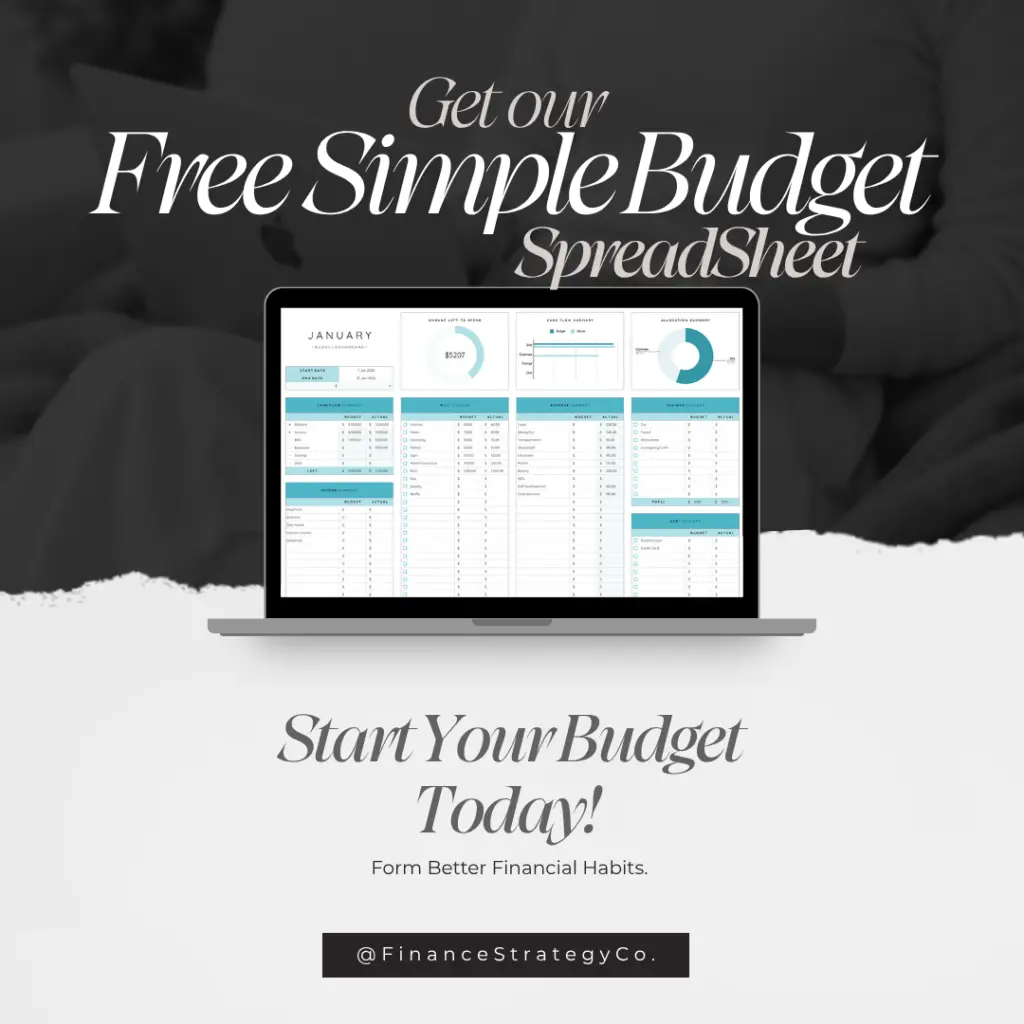
Finance Strategy Co. creates thoughtfully designed financial tools to help you organise your money, build better financial habits, plan meaningful goals and create a financial system around the life you actually want.
Money management, elevated.