

You are allowed to enjoy your money.
There is a strange relationship many of us develop with money.
We work hard to earn it.
We carefully save it.
We create budgets around it.
We think about our financial goals.
And then, when we finally spend some of it on something we enjoy…
We feel guilty.
Maybe you bought dinner at your favourite restaurant.
Perhaps you booked a holiday.
Maybe you purchased something beautiful for your home.
Or you simply treated yourself to something you’ve wanted for a while.
Instead of enjoying the purchase, you find yourself thinking:
“Should I really have spent that?”
“I could have saved that money.”
“Maybe I shouldn’t have bought it.”
But here’s the perspective we want to introduce at Finance Strategy Co.:
Money is not only for saving.
Money is also for living.
The goal isn’t to build a financial life where every purchase feels like a failure.
The goal is to create a strategy where you can save intentionally, spend intentionally and enjoy your money confidently.
Because there is a significant difference between:
Spending without a plan
and
Spending as part of a plan.
Why Do We Feel Guilty About Spending?
Money guilt can come from many places.
Perhaps you grew up hearing:
“Money doesn’t grow on trees.”
Maybe you were taught that spending money was irresponsible.
Perhaps you’ve experienced financial uncertainty.
Maybe you’ve worked incredibly hard to build your savings and now feel uncomfortable watching the balance decrease.
Or maybe you’ve created a budget so restrictive that every lifestyle purchase feels like you’ve broken a rule.
Sometimes the problem isn’t the purchase.
It’s the story we have attached to spending.
If you’ve been taught that being “good with money” means spending as little as possible, enjoying your money can feel wrong.
But financial responsibility isn’t measured by how little you spend.
It’s measured by how intentionally you use what you have.
Spending Isn't the Opposite of Financial Success
This is one of the most important mindset shifts.
Saving and spending aren’t enemies.
They serve different purposes.
Saving supports your future.
Spending supports your present.
You need both.
Imagine building a beautiful financial plan where every dollar is directed towards the future.
You save.
You invest.
You build an emergency fund.
You work towards your goals.
But you never allow yourself to enjoy your income.
At what point does the strategy stop serving you?
A financial plan should support your life, not prevent you from living it.
The Finance Strategy Co. Philosophy
This is why intentional spending is such an important part of the Finance Strategy Method™:
KNOW → ORGANISE → PLAN → BUILD → THRIVE
KNOW
Understand your income, expenses and spending habits.
ORGANISE
Create a clear structure for your money.
PLAN
Decide what matters most.
BUILD
Direct money towards your financial goals.
THRIVE
Enjoy the life your financial strategy is helping you create.
Notice something important.
The framework doesn’t end at BUILD.
It ends at:
THRIVE.
Because building financial security is important.
But so is enjoying the life you’re building it for.
The Difference Between Guilt-Free and Reckless Spending
Spending without guilt doesn’t mean spending without consideration.
There is a difference.
Reckless spending might look like:
Buying things you can’t afford.
Ignoring your financial commitments.
Using credit without a repayment strategy.
Constantly spending beyond your income.
Making purchases purely for emotional relief.
Intentional spending looks different.
You:
Know what you can afford.
Understand your priorities.
Have a spending plan.
Protect important financial goals.
Create room for enjoyment.
Make purchases consciously.
The goal isn’t to stop caring about money.
It’s to stop feeling guilty about responsible spending.
01 - Know Your Numbers
It’s difficult to spend confidently when you don’t know where you stand financially.
Before worrying about whether you “should” spend money, understand:
Your income
Your essential expenses
Your debt commitments
Your savings
Your financial goals
Your lifestyle spending
You don’t need to know every number perfectly.
You simply need enough clarity to make informed decisions.
Clarity creates confidence.
And confidence makes intentional spending much easier.
02 - Create a “Guilt-Free Spending” Category
This is one of my favourite strategies for building a healthier relationship with money.
Create a specific category in your budget for enjoyment.
You could call it:
Lifestyle
Fun Money
Personal
Enjoyment
Freedom
Guilt-Free Spending
The name doesn’t really matter.
The intention does.
If you’ve allocated $300 towards lifestyle spending this month, and you spend $80 on dinner with friends, that money was already accounted for.
You didn’t fail your budget.
You followed it.
03 - Give Yourself Permission Before You Spend
This sounds simple, but it can be surprisingly powerful.
Instead of buying something and then asking whether you should have done it, decide beforehand:
“I am allowed to spend this money.”
If the money has been allocated for lifestyle spending and your important financial commitments are covered, give yourself permission to use it.
This creates a mental shift from:
“I shouldn’t be spending this.”
to:
“This is exactly what I planned this money for.”
That distinction can completely change the emotional experience of spending.
04 - Decide What Is Worth It to You
Not every purchase needs to bring the same value.
Maybe you don’t care about expensive clothing.
But you love travelling.
Perhaps you don’t care about having the newest technology.
But you love eating at beautiful restaurants.
Maybe you don’t enjoy shopping.
But you value creating a beautiful home.
Your spending priorities don’t have to look like anyone else’s.
Create your own Worth It List.
ALWAYS WORTH IT
Things that genuinely improve your life.
SOMETIMES WORTH IT
Things you enjoy occasionally.
NOT WORTH IT
Things you purchase from habit, pressure or impulse.
This helps you spend more confidently on the things that matter.
05 - Stop Comparing Your Spending
Social media makes this difficult.
You see:
Luxury holidays.
Designer wardrobes.
Beautiful homes.
Restaurants.
Cars.
Experiences.
And it can create the feeling that everyone else is living better than you.
Then you may spend money trying to keep up.
Or feel guilty because you’re spending differently.
Neither is necessary.
Your financial life isn’t a competition.
Someone else’s priorities don’t need to become yours.
Spend according to your values, not someone else’s highlight reel.
06 - Separate “Can I Afford It?” From “Should I Buy It?”
These are two different questions.
You might be able to afford something.
That doesn’t necessarily mean you should buy it.
And you might genuinely value something even though it isn’t the cheapest option.
Instead ask:
Can I afford it?
Is it worth it to me?
Does it fit my current priorities?
Will it compromise anything important?
If the answers make sense:
You can spend with confidence.
07 - Create Financial Boundaries
Guilt often comes from uncertainty.
Clear boundaries can help.
For example:
I can spend up to $X on lifestyle purchases each month.
I wait 24 hours before significant purchases.
I save for large purchases rather than relying on credit.
I review my subscriptions regularly.
I don’t spend to impress other people.
I don’t use my savings for everyday lifestyle spending.
These boundaries create a framework.
And frameworks create freedom.
08 - Budget for the Things You Love
If you know you love travel, create a travel category.
If you love dining out, budget for restaurants.
If you love fashion, give clothing a realistic place in your budget.
If you love experiences, create an experiences fund.
Stop pretending you don’t value the things you consistently spend money on.
Instead, plan for them.
When something is intentionally included in your financial strategy, it becomes much easier to enjoy.
09 - Use Sinking Funds for Bigger Luxuries
Want something that doesn’t fit comfortably into one month’s budget?
Create a sinking fund.
For example:
TRAVEL FUND
Monthly contribution: $250
HOME FUND
Monthly contribution: $150
PERSONAL FUND
Monthly contribution: $100
EXPERIENCE FUND
Monthly contribution: $100
Now you’re not waiting for “extra money” to appear.
You’re deliberately creating the money for something you value.
And when you eventually spend it?
There is no need for guilt.
You planned for it.
10 - Understand the Difference Between Price and Value
Something can be expensive and still be valuable.
Something can be inexpensive and completely unnecessary.
A $20 purchase you don’t use isn’t necessarily better financially than a $200 purchase you use every week for years.
The question isn’t simply:
“How much does it cost?”
Consider:
“How much value will this bring into my life?”
That doesn’t mean using “value” to justify every purchase.
It means looking beyond the price tag.
11 - Don't Turn Frugality Into Your Identity
Being careful with money can be a wonderful habit.
But if you start believing that you’re only financially responsible when you’re spending as little as possible, you can create a difficult relationship with money.
You may feel guilty buying anything.
You may constantly look for the cheapest option.
You may struggle to enjoy your income.
Financial discipline shouldn’t become financial punishment.
You can be financially responsible and still enjoy beautiful things.
12 - Allow Yourself to Buy Quality
Intentional spending sometimes means buying fewer things.
Instead of purchasing several cheaper items you don’t really love, you might decide to save for one quality item.
This could apply to:
Clothing
Furniture
Technology
Homewares
Travel
Experiences
Quality doesn’t always mean expensive.
But the principle remains:
Choose deliberately.
13 - Stop Apologising for Responsible Spending
If you have:
Paid your bills.
Met your financial commitments.
Saved towards your goals.
Stayed within your spending plan.
And intentionally chosen to spend money on something you value…
You don’t need to apologise for it.
You don’t need to justify every dinner.
You don’t need to feel guilty about a holiday.
You don’t need to explain why you bought something you love.
You are allowed to enjoy the money you’ve responsibly allocated to enjoy.
14 - Create a “Future Me” and “Present Me” Budget
A beautiful way to think about money is to divide your strategy between two versions of yourself.
PRESENT ME
Money for:
Lifestyle.
Experiences.
Entertainment.
Personal spending.
Enjoyment.
FUTURE ME
Money for:
Savings.
Financial goals.
Emergency funds.
Investing where appropriate.
Long-term planning.
Neither version should completely dominate.
Present you deserves a life.
Future you deserves security.
Your financial strategy should care about both.
15 - Remember That Money Is a Tool
Money isn’t the destination.
It’s a tool.
It can help you create:
Security.
Freedom.
Experiences.
Comfort.
Opportunities.
Time.
Choice.
Connection.
When you look at money this way, spending becomes less about losing something and more about deciding what you want your money to accomplish.
Every financial decision is a choice about what your money does next.
16 - Use the “Would I Choose This Again?” Test
After making a purchase, don’t automatically regret it.
Instead, ask:
Did this bring me value?
Would I choose it again?
Did it align with what matters to me?
Was it worth the money?
If yes:
Remember that.
You’ve learned something about yourself.
If no:
Learn from that too.
Regret can become information rather than punishment.

17 - Create Your Personal Luxury List
Luxury means different things to different people.
For you, it might be:
A weekend away.
Fresh flowers.
A beautiful dinner.
Quality skincare.
A peaceful morning.
A comfortable home.
A good book.
Time with people you love.
A spontaneous experience.
Write down your version of luxury.
Then decide which luxuries genuinely matter.
The goal isn’t to have everything.
It’s to have the things that mean something to you.
18 - Spend on Experiences That Become Memories
Some spending creates temporary excitement.
Other spending creates memories.
A dinner with friends.
A family holiday.
A concert.
A weekend away.
A special celebration.
A class you’ve always wanted to take.
These experiences can become part of your life story.
Not all valuable spending comes in a box.
Sometimes the best return on your money is a memory.
19 - Don't Save Every Dollar “Just in Case”
Saving is important.
But there is a point where constantly postponing enjoyment can become another form of anxiety.
There will always be:
Another goal.
Another expense.
Another thing to prepare for.
Another amount you could save.
You don’t need to wait until you’ve reached some magical financial number before you’re allowed to enjoy your life.
Create balance.
Save responsibly.
Spend intentionally.
Enjoy today while preparing for tomorrow.
20 - Give Yourself a Spending Ritual
Make spending intentional.
Before a larger purchase:
Pause.
Review your budget.
Consider the value.
Check your priorities.
Decide.
If you choose to buy it, enjoy the experience.
Don’t spend the next week mentally punishing yourself.
The decision is complete.
Move forward.
What Guilt-Free Spending Actually Looks Like Imagine you want to book a $1,000 holiday.
Instead of:
“I can’t justify spending $1,000.”
You might say:
“I’ve saved $1,000 specifically for this experience. My financial commitments are covered, my savings plan is on track, and travel is one of my priorities.”
That’s not irresponsible spending.
That’s strategic spending.
The same purchase can feel completely different depending on the financial context behind it.

A Simple Guilt-Free Spending Framework
Before spending, move through these five questions:
01 — IS IT PLANNED?
Does it fit within your current financial strategy?
02 — CAN I AFFORD IT?
Can you comfortably make the purchase?
03 — DO I VALUE IT?
Does it genuinely matter to you?
04 — WILL IT COMPROMISE MY GOALS?
Will it interfere with something more important?
05 — CAN I ENJOY IT?
If you’ve made the decision intentionally, give yourself permission to enjoy it.
That’s the part many people forget.
What If You Feel Guilty Anyway?
Sometimes the numbers say it’s okay, but your emotions haven’t caught up.
That’s normal.
Try telling yourself:
“I planned for this.”
“This spending aligns with my priorities.”
“I am allowed to enjoy money.”
“One purchase doesn’t define my financial future.”
“Financial responsibility includes balance.”
Over time, these thoughts can become more natural.
Your Money Doesn't Need to Be Perfect
You will occasionally overspend.
You will make purchases you later question.
You will have expensive months.
You will change your priorities.
You will sometimes choose enjoyment over optimisation.
That’s life.
A sustainable financial strategy doesn’t require perfection.
It requires awareness and adjustment.
If something doesn’t work, change it.
If something brings genuine value, keep it.
If your priorities change, update your budget.
Your financial strategy should evolve with you.
The Finance Strategy Method™
This is why our approach begins with KNOW and ends with THRIVE.
KNOW
Understand your financial reality.
ORGANISE
Create clarity and structure.
PLAN
Give your money direction.
BUILD
Work towards financial security and meaningful goals.
THRIVE
Use your money to create a life you genuinely enjoy.
Because what’s the point of building a strong financial foundation if you never allow yourself to stand on it?
Your money should support your life, not replace it.
The Real Luxury Is Financial Confidence
There is a different feeling that comes with spending when you know your numbers.
You don’t need to panic.
You don’t need to hide the purchase.
You don’t need to justify every decision.
You don’t need to feel like enjoying your money means you’ve failed financially.
Instead:
You know what you’re doing.
You know why you’re doing it.
You know what your money is building.
And you know what you can comfortably enjoy.
That’s financial confidence.
And in many ways, that is the real luxury.
Spend With Intention, Not Guilt
The next time you make a purchase you’ve intentionally planned for, try something different.
Don’t immediately open your banking app and worry.
Don’t calculate how much you “could have saved.”
Don’t tell yourself you were irresponsible.
Instead:
Enjoy it.
You made a decision.
It aligned with your strategy.
It supported something you value.
Let the purchase be what it was meant to be:
Part of your life.
Your Money. Your Strategy. Your Life.
You don’t need to choose between:
Saving and living.
Security and enjoyment.
Discipline and freedom.
Financial goals and experiences.
A thoughtful financial strategy can make room for all of them.
Save for the future.
Plan for the unexpected.
Build towards your goals.
And create intentional space for the things that make life beautiful.
Because being good with money isn’t about never spending it.
It’s about knowing what deserves your money.
The Art of Guilt-Free Spending
There is an art to spending well.
It’s knowing when to say:
“No, this isn’t worth it.”
And knowing when to say:
“Yes. This matters to me.”
It’s saving before spending.
Planning before purchasing.
Choosing quality over quantity.
Prioritising experiences over comparison.
And understanding that your financial strategy exists to support the life you’re creating.
Spend on what you love.
Save for what matters.
Plan for your future.
Enjoy the present.
That is not financial irresponsibility.
That’s intentional living with money.
Ready to Create a Financial Strategy You Can Actually Enjoy?
Your money should feel organised enough to give you clarity and flexible enough to give you freedom.
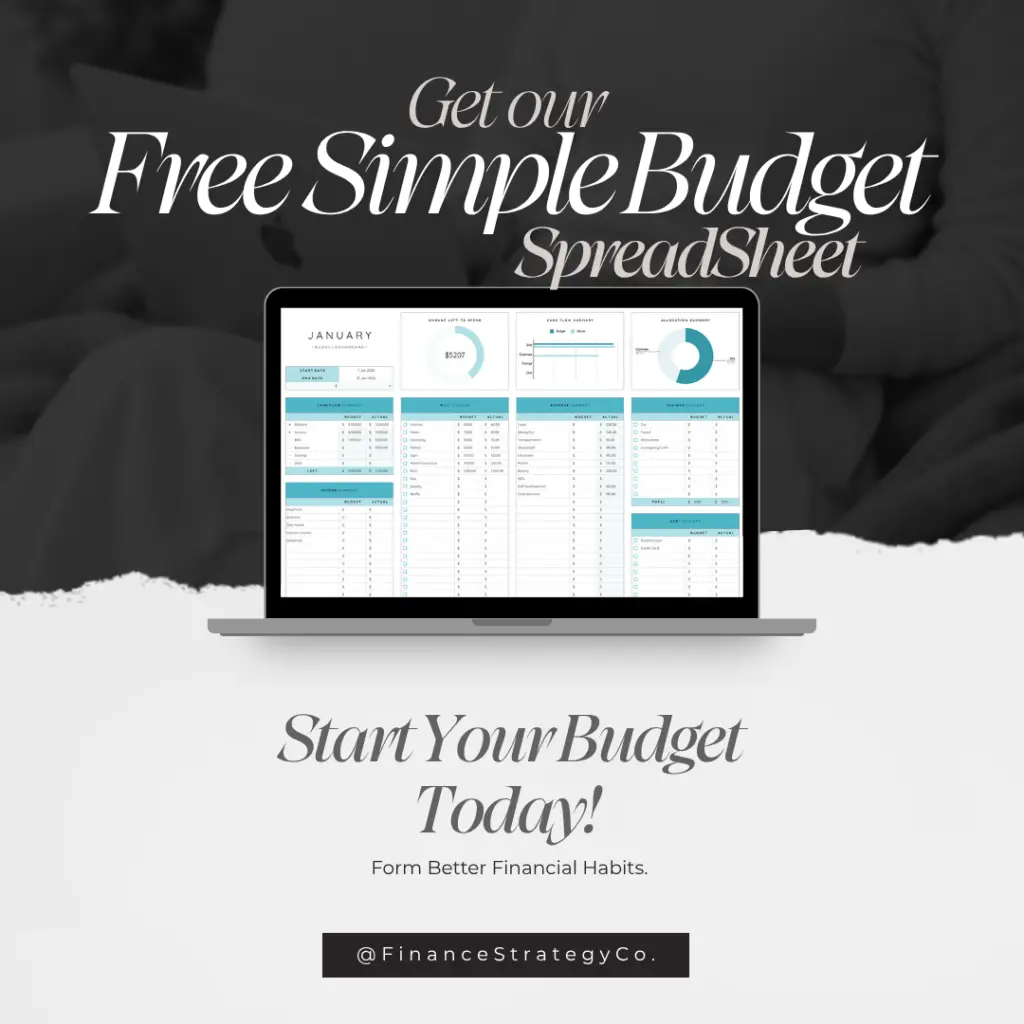
Explore the Finance Strategy Co. collection of thoughtfully designed budgeting, savings and financial planning tools created to help you organise your finances, track your goals and build a money strategy around the life you want.
Money management, elevated.