
Because being good with money doesn't mean feeling guilty every time you spend it.
There is a version of budgeting that tells you to cut back.
Spend less.
Say no.
Avoid unnecessary purchases.
Save everything you can.
And while there is certainly a place for being mindful with your money, constantly feeling guilty about spending isn’t a financial strategy.
It’s exhausting.
And eventually, it can make managing your money feel like punishment rather than empowerment.
At Finance Strategy Co., we believe your money should support your life—not make you feel guilty for living it.
A guilt-free spending plan gives you permission to spend on the things that matter while still protecting your financial priorities.
It isn’t about spending without limits.
It’s about creating intentional limits that leave room for life.
Because the goal isn’t to become someone who never spends.
It’s to become someone who knows why they’re spending.
What Is a Guilt-Free Spending Plan?
A guilt-free spending plan is a financial plan that deliberately makes room for both your responsibilities and the things you enjoy.
It accounts for:
- Your essential expenses
- Your financial goals
- Your savings
- Your debt commitments
- Your lifestyle
- Your personal priorities
- Your enjoyment
Instead of asking:
“What am I allowed to spend?”
you start asking:
“What can I comfortably spend while still taking care of what matters?”
That shift is powerful.
Your spending plan becomes less about restriction and more about permission with purpose.
A budget can help you see where your money is going, plan for expenses and make choices about what matters most.
And that includes enjoying some of your money.
Spending Money Isn't a Failure
Let’s get this out of the way first.
Spending money is not inherently bad.
You need to spend money to live.
You also might want to spend money on things that make your life more enjoyable.
A meal with friends.
A weekend away.
A beautiful piece of clothing.
A hobby.
A concert.
A massage.
A coffee on your way to work.
A book you’ve been wanting to read.
A special experience with your family.
None of these automatically mean you’re “bad with money.”
The question is whether the spending is intentional and sustainable.
There is a significant difference between:
“I bought this because I felt pressured, bored or impulsive.”
and
“I chose to spend money on this because it adds genuine value to my life and I planned for it.”
Both involve spending.
Only one involves strategy.
Why Do We Feel Guilty About Spending?
Money guilt can come from many places.
Perhaps you grew up hearing that spending money was irresponsible.
Maybe you’ve made financial mistakes in the past.
Perhaps you’re trying to recover from debt.
Maybe you’re comparing yourself to people who seem more financially successful.
Or perhaps you’ve convinced yourself that being financially responsible means never wanting anything.
Social media can make this even harder.
One person is telling you to save every dollar.
Another is telling you to live your best life.
Someone else is showing you their luxury lifestyle.
And somewhere in between all of that, you’re trying to figure out what actually works for you.
The answer isn’t necessarily to follow someone else’s rules.
It’s to create your own.

01 - Know Your Numbers
Before you create guilt-free spending, you need to know what you can realistically afford.
Start with:
Your income
What money comes in each pay cycle?
Your essential expenses
What needs to be paid?
Think:
- Housing
- Groceries
- Utilities
- Transport
- Insurance
- Healthcare
- Minimum debt repayments
Your financial priorities
What are you currently working towards?
For example:
- Emergency savings
- Debt reduction
- Holiday
- Home deposit
- Investing
- Future financial security
Your flexible spending
What changes from week to week or month to month?
Tracking your actual spending can help you understand your habits before deciding what to change. Moneysmart recommends reviewing recent transactions and grouping expenses to get a clearer picture of where your money goes.
Clarity comes before confidence.
You can’t create a spending plan that feels good if you don’t know what you’re working with.
02 - Cover the Essentials First
Your guilt-free spending comes after your core financial responsibilities have been accounted for.
Think of your money in layers.
LAYER ONE – LIFE
Your essential expenses.
LAYER TWO – FUTURE
Your savings, debt reduction and longer-term goals.
LAYER THREE – LIFESTYLE
The things you enjoy today.
This doesn’t mean lifestyle spending is unimportant.
It means you’re creating a structure where your enjoyment isn’t constantly competing with your financial security.
That’s the difference between reckless spending and planned enjoyment.
03 - Create a “Guilt-Free” Category
This might be the most important part of the entire plan.
Create a specific category for spending that is allowed.
Call it whatever feels natural:
Guilt-Free Spending
Fun Money
Lifestyle
Personal
Joy
Enjoyment
The name doesn’t matter.
The message does.
When you’ve allocated money to this category, you have already decided:
“This money is available for me to enjoy.”
Once you’ve spent within that amount, you don’t need to punish yourself for it.
You don’t need to replay the purchase in your head.
You don’t need to feel like you should have saved every dollar.
You planned for it.
You can enjoy it.
04 - Decide What Is Worth It to You
Not all spending brings the same value.
This is where your spending plan becomes personal.
Ask yourself:
What makes my life better?
What gives me energy?
What saves me time?
What strengthens my relationships?
What supports my health?
What experiences do I want more of?
What purchases do I consistently enjoy?
What do I rarely regret spending money on?
These answers become your priority spending categories.
For one person, that might be travel.
For another, it might be health.
Someone else may prioritise their home, family, fashion, dining, education or hobbies.
There is no universal answer.
Your budget doesn’t need to look like someone else’s.
05 - Create Your “Worth It” List
Take five minutes and write:
MY WORTH-IT LIST
Complete the sentence:
“I’m happy to spend money on…”
Then list everything that genuinely matters to you.
For example:
- Travel
- Experiences
- Good food
- Fitness
- Beauty
- Family
- Quality clothing
- Books
- Home
- Education
- Convenience
- Hobbies
- Time with friends
Then look at your list.
You might notice something interesting.
The things you genuinely value may not be the things you’re currently spending the most money on.
And that’s where your strategy gets interesting.
06 - Create Your “Not Worth It” List
Now do the opposite.
MY NOT-FOR-ME LIST
What are you spending money on that doesn’t actually matter to you?
Perhaps:
- Trend purchases
- Unused subscriptions
- Random online shopping
- Takeaway you don’t particularly enjoy
- Buying things because they’re discounted
- Spending to keep up with friends
- Purchases you immediately forget about
- Convenience that doesn’t actually save you meaningful time
This isn’t about labelling these things “bad.”
They’re simply not your priorities.
And when you know what isn’t important, it’s much easier to redirect your money towards what is.
07 - Give Yourself a Spending Allowance
A spending allowance can be incredibly freeing.
Instead of constantly wondering:
“Should I buy this?”
you can simply look at your available lifestyle spending.
For example:
Monthly guilt-free spending: $400
That might cover:
- $100 dining out
- $75 personal spending
- $75 entertainment
- $50 coffee/treats
- $100 flexible lifestyle spending
Your numbers will be completely personal.
The point is to create a defined amount that you can spend without second-guessing every purchase.
And remember:
Your spending allowance isn’t a reward for being financially responsible.
It’s part of your financial plan.
08 - Don't Make Your Spending Plan Too Tight
One of the biggest mistakes people make is creating a budget that looks perfect on paper but feels impossible in real life.
They budget:
$0 for fun.
$0 for unexpected spending.
$0 for flexibility.
$0 for anything enjoyable.
And then wonder why they can’t stick to it.
A sustainable spending plan needs breathing room.
Moneysmart recommends creating a budget that works with your lifestyle and reviewing it when your income, expenses or goals change.
Your plan doesn’t need to be perfect.
It needs to be realistic enough to live with.
09 - Build in Irregular Spending
Some of the guilt we experience around spending comes from expenses we forgot were coming.
Birthdays.
Christmas.
Annual subscriptions.
Car registration.
Hair appointments.
Home maintenance.
School expenses.
Travel.
Insurance.
Medical expenses.
These aren’t necessarily “unexpected.”
They’re simply irregular.
Create sinking funds for expenses you know will arrive eventually.
That way, when the expense appears, you’re not thinking:
“I’ve ruined my budget.”
Instead:
“I’ve already planned for this.”
That is financial peace.
10 - Create a “No Questions Asked” Amount
Here’s a fun idea:
Choose a small amount of money that you can spend without analysing it.
Maybe it’s:
$20 per week.
Or:
$50 per fortnight.
Or whatever amount makes sense for your circumstances.
The rule is simple:
Once it is allocated, you don’t need to justify every little purchase.
Coffee?
Fine.
Lunch with a friend?
Fine.
A magazine?
Fine.
A small treat?
Fine.
This isn’t about encouraging unnecessary spending.
It’s about recognising that constant financial scrutiny isn’t the goal.
Your financial system should give you freedom to make small everyday choices without turning every purchase into a moral decision.
11 - Use the “Can I Afford It?” Test Differently
Instead of only asking:
“Can I afford this?”
ask three questions:
1. Can I afford this financially?
Will buying it compromise bills, savings or important commitments?
2. Do I actually want it?
Or am I buying because of boredom, pressure, comparison or impulse?
3. Is it worth it to me?
Will this purchase add enough value to justify the money?
If the answer to all three is yes:
Buy it.
And enjoy it.
You don’t need to feel guilty about a purchase that was affordable, intentional and aligned with your priorities.
12 - Stop Comparing Your Spending
This one deserves its own section.
Someone else’s priorities aren’t your priorities.
You might look at someone travelling constantly and wonder why you aren’t doing the same.
Someone else might look at your spending and wonder why you don’t have the things they value.
That’s because money is personal.
The goal isn’t to create the most impressive lifestyle.
It’s to create a lifestyle that feels right for you.
You don’t need to spend money to prove you’re successful.
And you don’t need to avoid spending money to prove you’re responsible.
You simply need a strategy that reflects your life.
13 - Give Every Dollar a Job
A powerful spending plan gives your money direction.
Instead of:
“I have $500 left.”
Think:
“I have $500 allocated across my priorities.”
For example:
| Purpose | Amount |
|---|---|
| Essentials | $2,000 |
| Savings | $500 |
| Debt | $300 |
| Future goals | $200 |
| Lifestyle | $400 |
| Flexible spending | $100 |
These numbers are simply an illustration—not a universal formula.
The important part is that your money has somewhere intentional to go.
A budget is essentially a plan for money coming in and going out, and it can help you decide what matters most while identifying areas where you may want to reduce spending.

The Guilt-Free Spending Formula
If you want to keep this simple, remember:
EARN → PROTECT → PRIORITISE → ENJOY
EARN
Know what money is coming in.
PROTECT
Cover your essential expenses and financial responsibilities.
PRIORITISE
Allocate money towards savings, goals and the things that matter most.
ENJOY
Spend what’s intentionally available for your lifestyle.
This is what balance can look like.
Not perfect.
Not restrictive.
Balanced.
The 30-Minute Guilt-Free Spending Reset
Want to create yours today?
Set a timer for 30 minutes.
MINUTES 1–5
Write down your income.
MINUTES 6–10
List your essential expenses.
MINUTES 11–15
Write down your savings and financial goals.
MINUTES 16–20
Review your recent spending.
MINUTES 21–25
Create your Worth It and Not For Me lists.
MINUTES 26–30
Choose your guilt-free spending amount.
That’s it.
You don’t need a complicated spreadsheet.
You don’t need to completely transform your finances overnight.
You simply need to start giving your money direction.
What If You Spend More Than Planned?
You will.
At some point.
Everyone does.
Maybe you have an expensive month.
Maybe you go on holiday.
Maybe you have an unexpected event.
Maybe you simply overspend.
The answer isn’t:
“I’ve failed.”
It’s:
“What happened, and what do I want to adjust?”
Review the month.
Look at what changed.
Make an adjustment.
Continue.
Moneysmart recommends reviewing and adjusting your budget as your circumstances change rather than treating it as a fixed document.
One expensive weekend doesn’t define your financial habits.
Your overall pattern matters more.
The Quiet Luxury of Spending Without Guilt
There is something incredibly luxurious about knowing that you can enjoy your money without fear.
Not because you have unlimited money.
Because you have clarity.
You know what your bills are.
You know what you’re saving for.
You know what you’re working towards.
You know what matters.
And you know what you can comfortably spend.
That is a different kind of wealth.
The kind that lets you sit down for dinner with friends and actually enjoy the evening.
The kind that lets you book the holiday you’ve been saving for without wondering if you’re being irresponsible.
The kind that lets you buy something beautiful without turning the purchase into a personal failure.
Financial confidence isn’t never spending.
It’s knowing that your spending has a place.
The Finance Strategy Method™
At Finance Strategy Co., we believe money should have direction.
That’s why a guilt-free spending plan fits naturally into The Finance Strategy Method™:
KNOW
Understand your income, expenses and spending habits.
ORGANISE
Create a clear system for bills, spending and savings.
PLAN
Decide what matters and allocate your money accordingly.
BUILD
Strengthen your savings, financial security and long-term wealth.
THRIVE
Create a financial life that gives you room to enjoy the present while building your future.
Because the ultimate goal isn’t to become someone who never spends.
It’s to become someone who can say:
“I know what my money is doing, and I feel good about it.”
Your Money Should Make Room for Your Life
You don’t need a budget that makes you feel guilty.
You need one that makes you feel clear.
Clear about what you can spend.
Clear about what you’re saving for.
Clear about what matters.
Clear about what you don’t need.
And confident enough to enjoy the money you’ve intentionally set aside for yourself.
So create the plan.
Pay the bills.
Save for the future.
Build your financial security.
And then let yourself enjoy your life.
Because being financially responsible doesn’t mean saying no to everything.
Sometimes, financial responsibility looks like knowing exactly when you can say yes.
Spend intentionally. Save confidently. Live fully.
Your money. Your strategy. Your future.
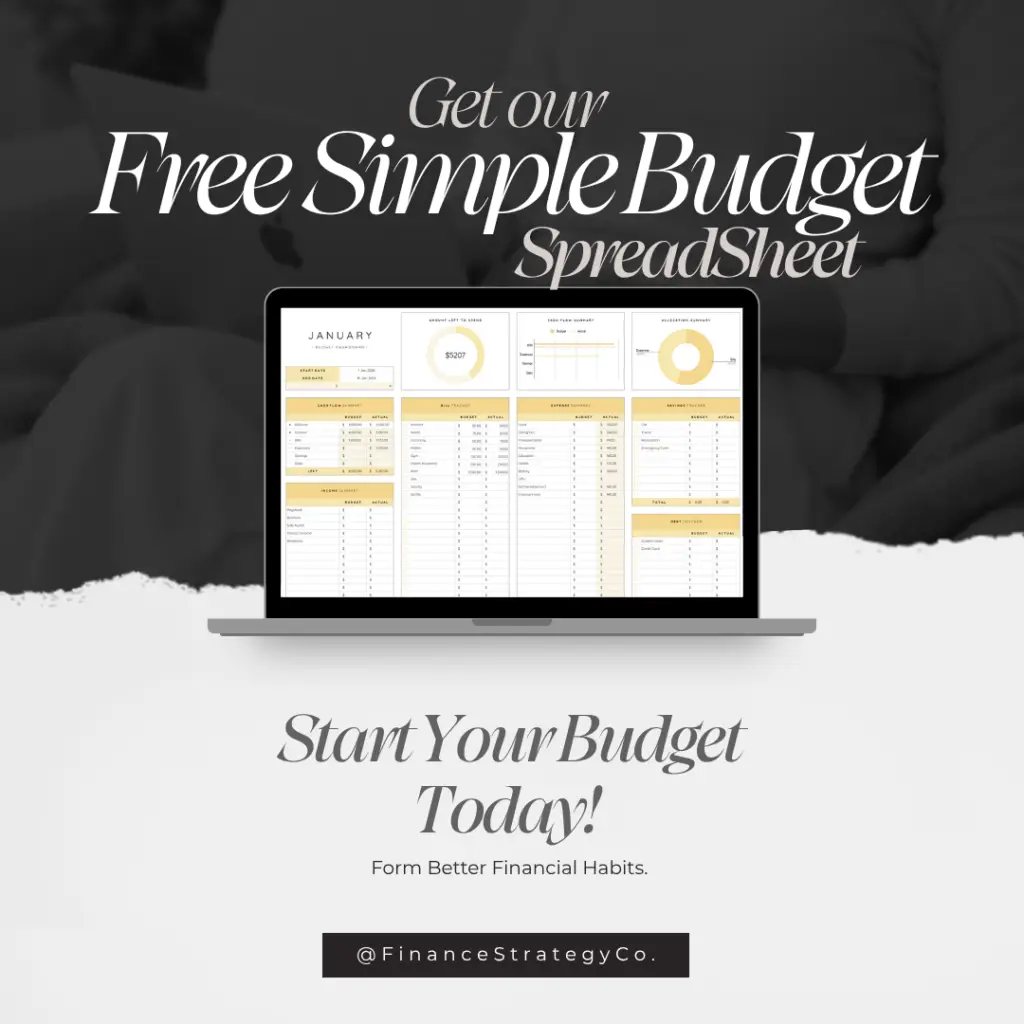
Ready to Build Your Strategy?
Finance Strategy Co. creates thoughtfully designed financial tools to help you organise your money, clarify your goals and build a financial system that fits your life.
Money management, elevated.