

Saving your first $1,000 can feel surprisingly difficult. Especially when you're starting from $0.
Your first $1,000 isn't just money in a savings account. It's breathing room, confidence and the beginning of a financial strategy that can change the way you feel about money.
You might look at the goal and think, Where am I supposed to find an extra $1,000?
But here’s the thing:
You don’t need to find $1,000. You need to create a system that gets you there.
It might take a few months. It might take longer. You may need to adjust your target along the way.
That’s okay.
The goal isn’t to save perfectly.
The goal is to start building the habit of paying yourself first, making intentional choices with your money and creating a little more financial breathing room.
And once you reach that first $1,000?
You’ll have something much more valuable than the number itself.
You’ll have proof that your money can work differently.
Why Your First $1,000 Matters
There is something powerful about having money set aside that you don’t need to spend immediately.
It creates a buffer between you and the unexpected.
A car repair.
An urgent bill.
A last-minute expense.
A week where your usual budget simply doesn’t stretch as far as expected.
Moneysmart describes an emergency fund as a financial safety net for urgent or unexpected costs and notes that even saving small amounts can help you build towards greater financial breathing room.
Your first $1,000 doesn’t solve every financial problem.
It isn’t meant to.
It’s your first layer of financial protection.
And perhaps even more importantly, it can change your relationship with saving.
Instead of thinking:
“I’m terrible at saving.”
You start thinking:
“I can save.”
That shift matters.

01 - Give Your $1,000 a Purpose
Before you start transferring money into a savings account, decide why you’re saving it.
A goal with a purpose is easier to protect.
Your first $1,000 might be for:
- An emergency buffer
- Unexpected expenses
- Car repairs
- Medical or dental costs
- A future move
- A financial safety net
- Your first savings milestone
- Simply creating breathing room
You don’t have to know exactly what you’ll eventually use the money for.
If you’re building your first emergency fund, your purpose can simply be:
“This money is here so I don’t have to panic when something unexpected happens.”
Write the goal somewhere you can see it.
FIRST $1,000.
Not $10,000.
Not $50,000.
Not financial freedom overnight.
Just your first $1,000.
Moneysmart recommends setting a clear savings goal because knowing what you’re saving for can help you stay motivated and determine how much you need to save and how long it may take.
02 - Start With Your Numbers
Before cutting expenses, take a look at what’s actually happening with your money.
You can’t create a realistic savings strategy without knowing what you’re working with.
Start with:
Income
How much money comes into your account each pay cycle?
Essential expenses
What do you need to pay for housing, groceries, transport, utilities, insurance and other necessities?
Debt repayments
What minimum repayments are currently required?
Flexible spending
How much are you spending on eating out, shopping, entertainment, subscriptions and other lifestyle expenses?
Irregular expenses
What expenses appear throughout the year rather than every week or month?
Look through your recent bank transactions and statements.
You aren’t looking for reasons to feel guilty.
You’re looking for information.
Because clarity comes before strategy.
Tracking your spending can help you identify patterns, understand where your money is going and find opportunities to save.
03 - Choose Your $1,000 Timeline
Now turn the big number into a smaller number.
This is where $1,000 starts to feel much more achievable.
Save $20 a week
You’d save approximately:
$1,040 in one year.
Save $25 a week
You’d save approximately:
$1,300 in one year.
Save $50 a week
You’d reach:
$1,000 in 20 weeks.
Save $100 a week
You’d reach:
$1,000 in 10 weeks.
Save $125 a week
You’d reach:
$1,000 in 8 weeks.
The right amount isn’t necessarily the largest amount.
It’s the amount you can consistently live with.
A savings goal that looks impressive on paper but leaves you constantly short of money isn’t a strong strategy.
A smaller amount that you can maintain is often much more sustainable.
Moneysmart similarly recommends choosing a savings amount and schedule that fit your day-to-day circumstances and adjusting the plan when your income, expenses or priorities change.
04 - Create a Dedicated Savings Account
Make your $1,000 harder to accidentally spend.
If possible, keep your savings separate from your everyday spending money.
You don’t want to open your banking app, see $1,000 sitting beside your spending balance and think:
“I could really use that right now.”
Your savings should have a job.
Give it a name.
Emergency Fund
Financial Buffer
Future Me
First $1,000
Whatever makes the goal feel meaningful to you.
Moneysmart recommends keeping savings separate from everyday spending and notes that a separate savings account can make it easier to track your progress and reduce the temptation to dip into the money.
05 - Automate the Habit
This might be the most important step.
Don’t rely on motivation.
Create a system.
Set up an automatic transfer to your savings account when you get paid.
For example:
Payday → Savings → Bills → Spending
Instead of:
Payday → Spend → Hopefully save what’s left
There is a very different psychology behind those two approaches.
When saving happens automatically, you don’t have to make the decision every time.
Moneysmart recommends automatic transfers as a simple way to make saving easier and more consistent.
Even if your first automatic transfer is only $20.
Start there.
You can increase it later.
06 - Find Your "Easy Wins"
You don’t need to cut every enjoyable thing from your life to save $1,000.
This isn’t about creating a miserable budget.
Instead, look for expenses you don’t actually value.
Ask yourself:
What am I paying for but barely using?
Subscriptions are a good place to start.
What purchases happen automatically?
Look at recurring payments, memberships and regular online spending.
Where am I spending out of habit?
Perhaps takeaway happens because you’re tired rather than because you genuinely want it.
What could I temporarily reduce?
Maybe it’s shopping, dining out, entertainment or convenience spending.
What expenses don’t align with my priorities?
This is where budgeting becomes more than restriction.
You’re not asking, “What can I stop buying?”
You’re asking:
“What deserves my money?”
That is a very different conversation.
07 - Try the $1,000 Money Leak Audit
Take 30 minutes.
Open your bank account and review your recent transactions.
Look for:
- Forgotten subscriptions
- Frequent takeaway purchases
- Unused memberships
- Online shopping
- Convenience spending
- Bank fees
- Duplicate services
- Impulse purchases
- Frequent small purchases
- Expenses that no longer reflect your lifestyle
Then create three columns:
KEEP
Expenses that genuinely support your life.
REDUCE
Expenses you enjoy but could spend less on.
REMOVE
Expenses that no longer deserve a place in your budget.
You don’t need to eliminate everything in the second and third columns.
You’re simply creating awareness.
Small changes can become meaningful when they’re repeated.
08 - Add "Found Money" to Your Goal
Your regular savings contribution doesn’t have to do all the work.
Whenever unexpected money comes your way, consider putting some or all of it towards your $1,000 goal.
That could include:
- A tax refund
- A work bonus
- Cashback
- Selling unused items
- A gift of money
- An unexpected rebate
- Extra work income
- Money saved from cancelling a service
You don’t have to send every unexpected dollar to savings.
The idea is simply to recognise opportunities when they appear.
A $50 unexpected deposit might not feel significant.
But when you’re working towards $1,000, it suddenly represents 5% of your goal.
09 - Make Saving Visible
Saving becomes much more motivating when you can see yourself getting closer.
Create milestones.
$100 – START
You’ve begun.
$250 – BUILD
You’re creating momentum.
$500 – HALF WAY
You’re proving that your strategy works.
$750 – ALMOST THERE
The finish line is visible.
$1,000 – FIRST MILESTONE
You’ve done it.
Celebrate the milestone.
Not by immediately spending it.
But by recognising what you’ve built.
The goal isn’t just the money. It’s the habit behind the money.
Moneysmart recommends tracking your savings progress and celebrating small wins as ways to stay motivated.
10 - Don't Let a Setback Become a Stop Sign
There may be a month when you can’t save.
You might have an unexpected expense.
You might need to use some of your savings.
Your income could change.
Life happens.
That doesn’t mean you’ve failed.
If you need to use your emergency savings for a genuine emergency, use it.
That’s what it’s there for.
Then rebuild.
Your financial strategy should be flexible enough to survive real life.
If you save $600 and then need $200 for an unexpected expense, you haven’t gone backwards.
You have still built a $400 financial buffer that you didn’t have before.
Progress isn’t always linear.

Your First $1,000 Savings Plan
Here’s a simple framework you can use.
KNOW
Understand your income, expenses and spending patterns.
ORGANISE
Create a separate savings account and make your goal visible.
PLAN
Choose how much you can realistically save each week, fortnight or month.
BUILD
Automate your savings and look for opportunities to add extra money.
THRIVE
Once you reach $1,000, decide what your next financial milestone should be.
That’s the Finance Strategy Method™ in action.
Know → Organise → Plan → Build → Thrive.
The $1,000 Challenge
If you want to make this practical, try this simple challenge.
Week 1
Know your money.
Review your income and recent spending.
Week 2
Find your opportunities.
Cancel, reduce or rethink a few expenses that don’t align with your priorities.
Week 3
Set your system.
Open or designate your savings account and automate your contribution.
Week 4
Build momentum.
Look for ways to add extra money without relying solely on cutting your lifestyle.
Then repeat.
Your timeline doesn’t matter as much as creating a system you can maintain.
What Happens After You Save $1,000?
This is where things get interesting.
Your first $1,000 isn’t the finish line.
It’s your foundation.
Once you’ve reached it, you might decide to:
- Continue building your emergency fund
- Create sinking funds for upcoming expenses
- Pay down high-cost debt
- Increase your savings rate
- Start working towards a larger financial goal
- Begin learning about investing
- Build your net worth
- Create a one-year financial plan
For emergency savings specifically, Moneysmart currently suggests aiming for around three months of expenses as a longer-term target, although the right amount depends on your circumstances.
So don’t look at $1,000 and think:
“That’s not enough.”
Look at it and think:
“This is where I’m starting.”
The Quiet Power of $1,000
There is something deeply empowering about having money set aside.
Not because $1,000 makes you wealthy.
It doesn’t.
But because it gives you something many people are missing:
a little breathing room.
And breathing room creates choices.
It can mean an unexpected expense doesn’t immediately become a credit card balance.
It can mean you have somewhere to turn when life gets expensive.
It can mean you begin to trust yourself with money.
And perhaps that’s the most important part.
Saving your first $1,000 isn’t about becoming perfect with money.
It’s about proving that you can create a plan, follow it, adjust it and keep going.
Your first $1,000 is not just a number.
It’s your first financial milestone.
And from there, you can build.
A Final Reminder
You don’t need a six-figure income to begin building better money habits.
You don’t need a perfect budget.
You don’t need to completely change your lifestyle.
And you certainly don’t need to save $1,000 overnight.
Start where you are.
Choose an amount that fits your life.
Create a system.
Make saving automatic.
Stay curious about where your money is going.
And keep moving forward.
Because financial confidence isn’t built in one dramatic moment.
It’s built through small decisions, repeated consistently.
Your money doesn’t need more pressure.
It needs a strategy.
Your money. Your strategy. Your future.
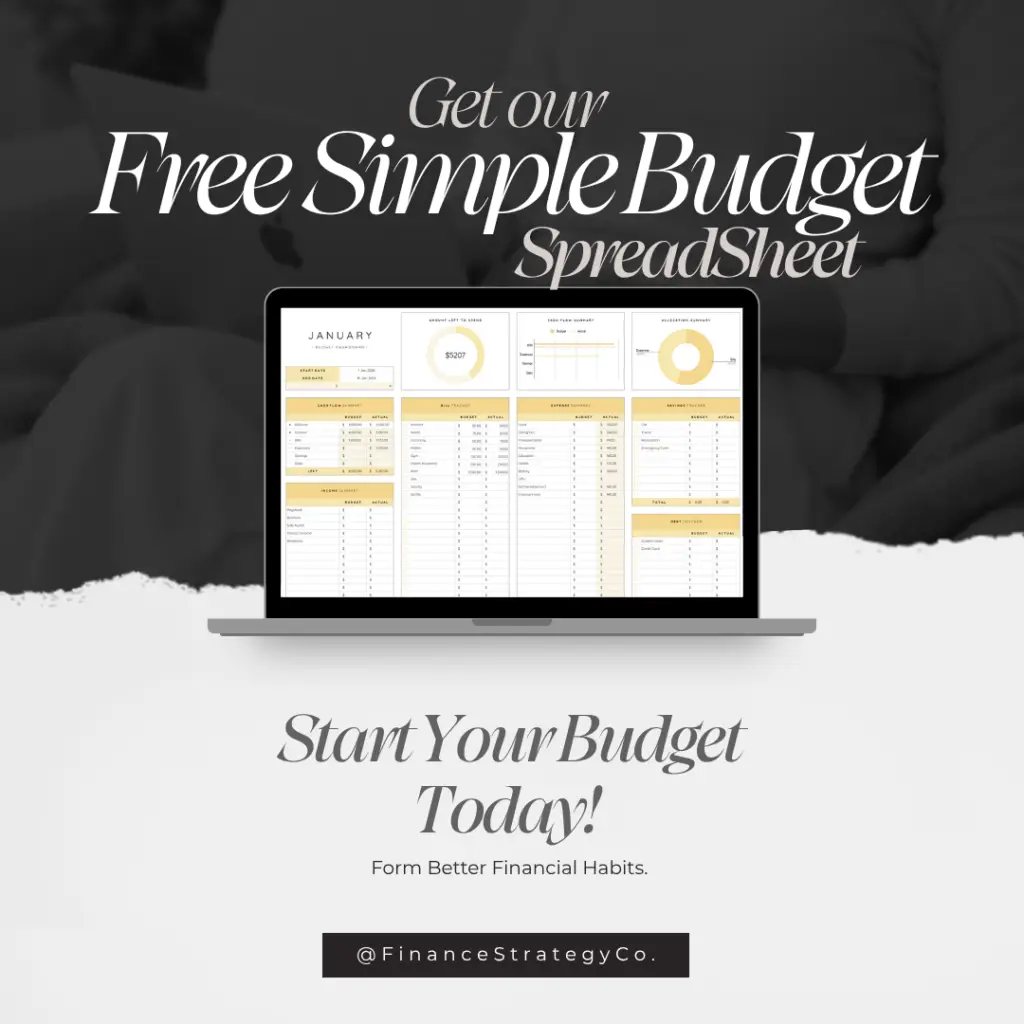
Ready to Make Your Money Work Around Your Life?
Your financial system should make intentional spending and saving easier.
Explore the Finance Strategy Co. collection of thoughtfully designed budgeting, savings and financial planning tools created to help you organise your money, track your goals and build a strategy that fits your lifestyle.
Money management, elevated.